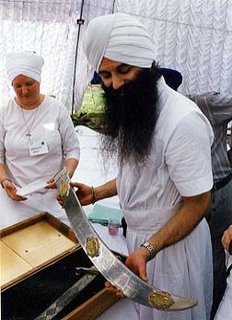
 Jot Singh Khalsa is a weapons master who is a trained metal smith. Jot Sing grew up in Mills, Massachusetts and when he was 19 started studying fine arts at college, with a focus on gold and silversmithing. He started studying Kundalini Yoga, which he has done for over 30 years, and through this he met Yogi Bhajan. He found the Sikh religion appealing so decided to become a Sikh. Coming into contact with the Sikh religion he came across the Sikh Kirpan (click here to learn more about the 5 K's) which Sikh's wear to remind them to be a protector of the weak and innocent. So he started making Sikh Kirpan's after making his first knife in 1977. He has won many awards for his knife making , including Best Damascus Knife from Damascus USA, Best Art Knife from the Chicago Custom Knife Show and Best Knifemaker at the California Knife Show. Jot Singh is a full practising Sikh and is also a Sikh Minister.
Amongst his works he has made a sword with the entire Jaap Sahib prayer by Guru Gobind Singh to commemorate 300 years of the Khalsa in 1999. Besides forging the blade and metal work, he also supervised the engraving and finishing work. Jot Singh’s wife, Harbhajan Kaur, collected the many donations that funded the expense of the sword. Below are some images of this special sword and other examples of his work.


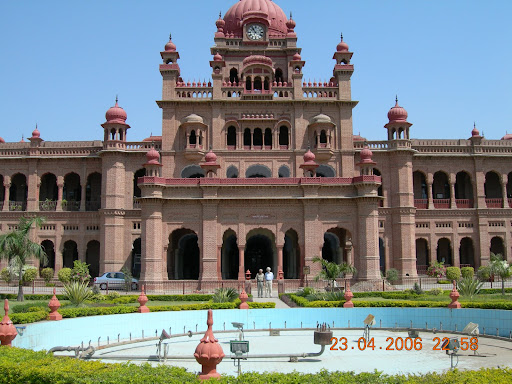
 Bhai Ram Singh was an architect who designed

 Parmjit Singh Dhanda, born September 17, 1971, is a British Labour Party politician for Gloucester. He is the youngest Asian MP in the UK parliament. He was elected Member of Parliament for Gloucester in the 2001 general election, succeeding Tess Kingham as the Labour MP for the seat. He was re-elected in the 2005 general election. Parmjit attended the University of Nottingham, where he received a Bachelor of Engineering degree in 1993, and a MA in information technology in 1995. Parmjit Dhanda is married and lives with his family in Matson, Gloucester. Has been a member of the Union of Shop, Distributive and Allied Workers (USDAW) since 1999. He speaks both Punjabi and French, in addition to English. Parmjit Dhanda became a Labour Party organiser in West London, Hampshire and Wiltshire in 1996, then went on to be assistant national organiser with Connect in 1998 where he remained until he was elected to Westminster. He was elected as a councillor in the London Borough of Hillingdon in 1998 and served on the council until 2002. He was selected to contest the House of Commons seat of Gloucester at the 2001 General Election following the retirement of Tess Kingham. Parmjit Dhanda held the seat with a majority of 3,880 and has remained an MP since. In parliament, Parmjit Dhanda became a member of the Science and Technology Select Committee from his election until 2003. He helped setup an all-party group on Telecommunications, of which he's a Secretary.
 Marshal of the Air Force Arjan Singh, born 15th April 1919, is the only officer of the Indian Air Force to be promoted to five star rank, equal to a Field Marshal, to which he was promoted in 2002. He is also the first Marshal of the Air force. He was born in the Punjab Lyalpur, British India, into an Aulakh family. After the death of Field Marshal Sam Manekshaw in June 2008, he is the only living Indian military officer with a five-star rank. He was educated at Montgomery India (now in Pakistan). He entered the RAF College Cranwell in 1938 and was commissioned as a Pilot Officer in December 1939. He led No.1 Squadron, Indian Air Force into command during the Arakan Campaign in 1944. He was awarded the Distinguished Flying Cross (DFC) in 1944, and commanded the Indian Air Force Exhibition Flight in 1945. Arjan was the Chief of Air Staff or CAS, from 1 August 1964 to 15 July 1969, and was awarded the Padma Vibhushan in 1965, India's second highest civilian honour given for exceptional and distinguished service to India. He was Lt. Governor of Delhi and was made Marshal of the Air Force in January, 2002. He has flown 65 different types of aircraft. His life story is the subject of a book by Roopinder Singh called Arjan Singh: Marshal of The Indian Air Force. Rupa & Co (2002). Arjan has also been an ambassador fr India to Switzerland.
 Talvin Singh, born 1974 in London, is a producer, composer and tabla player, known for creating an innovative fusion of classical Indian music and drum n bass. Talvin Singh is generally considered to be involved with an electronica sub genre called Asian Underground. Talvin grew up in Leytonstone and began playing the tabla, breakdancing and listening to punk rock as a child. At the age of 15, he went to India where he studied tabla under Pandit Lashman Singh, returning to the UK after just one year. In spite of this classical training, Singh's tabla playing was not accepted by British promoters of classical Indian music, as he incorporated too many western influences. By the late 1980s, Singh had decided to turn towards the fusion of sounds, and soon he began working as a musician with such artists as Madonna, the Indigo Girls, David Sylvian, Siouxsie & the Banshees, Sun Ra, Björk, Massive Attack and the Future Sound of London. Talvin signed to Island records for a compilation including several of his own productions. He worked as a remixer until releasing his solo debut, OK, in 1999. The album was recieved well and he won the Mercury Music Prize for 1999.
 Sir Sobha Singh (1901-1986) is arguably the most well known contemporary painter Punjab has ever produced and is amongst the greatest Indian artists of the twentieth century. He was born on 29 November 1901 in a Ramgarhia Sikh family in Sri Hargobindpur, Gurdaspur district of Punjab and his father, Deva Singh, was in the Indian cavalry. He learnt and mastered painting by self practice. In 1919 he was present at the Jalianwala Bagh at the time of the shootings. Later, he joined the British India army as a draughtsman and was posted at various places in Iraq. He studied European Paintings and got inspiration from the works of English painters. At the age 15, Sobha Singh entered the Industrial School at Amritsar for a one-year course in art and crafts. In 1949 after the partition he was forced to move from Lahore, where he had opened a studio at Anarkali, he then settled down in Andretta near Palampur, a remote and picturesque village in the Kangra valley of Himachal Pradesh beginning his career as a painter. His paintings of Sohni Mahiwal and Heer Ranjha proved very popular, his series on the Sikh guru's Guru Nanak and Guru Gobind Singh are amongst the most mass produced pictures of the Guru's. Some of his murals are displayed in the art gallery of the Indian parliament House in New Delhi. He painted Sohni Mahiwal, one of the most popular love legends of Punjab, for the first time in 1937 and he also worked on other love tales of Punjab. Heer Ranjha, Sassi Punnu, Shirin Farhad and Mirzan Sahiban are other beautiful paintings. Sobha also dabbled in sculpture, sculpting the busts of eminent Punjabi's such as M.S. Randhawa, Prithviraj Kapoor, the patriarch of the Kapoor family, and Nirmal Chandra. The originals of his works are still displayed in his studio at Andretta. Sobha Singh died in Chandigarh on 21 August 1986. In his honour the Indian Government issued a postal stamp in 2001 and the road linking the Palampur town and Andretta has been renamed in his honour. Sir Sobha Singh is pictured with Amrita Pritam of whom he was sculpting a bust of, but did not complete. Below are a selection from some of his best artworks, from top Sohni Mahiwal, Palace of Bhutan and Shaheed Bhagat Singh.


 Jeev Milkha Singh, born born 15 December 1971 in Chandigarh, India, was the first Indian golfer to become a member of the European Tour. He has been the highest ranked Indian golfer in the world and first broke into the top 50 in October 2006, moving from 104th to 48th. He is the son of the famous Olympic athlete Milkha Singh who represented India in 200m and 400 races for the 1960 and 1964 Summer Olypics. Jeev won the NCAA Division II individual golf championship in 1993 and his first professional win was also in 1993 at the Southern Oklahoma State Open. In 2006 he won the Volvo China Open and he also won the Volvo Masters, taking home $840,000 in prize money which was at the time the biggest cheque won by an Indian in individual sport. In 2007 he became the first Indian player in the US Masters. He won the Asian Tour's Order of merit, given to the number 1 player, for 2006 and again in 2008, becoming the first player to do this. He was awarded the Player's Player of the Year award in 2008 and became the first Asian golfer to earn more than $1 million in a single season, amassing a whopping $1.45 million in 11 tournaments. In 2008 Jeev won the Australian Open title, Singapore Open, for which he was awarded $792,500 and the Golf Nippon Series JT Cup for the 2nd time. Famous Sikhs thinks golf is a very lucrative sport and Sikhs should definitely be encouraged to play, especially now that there are players like Jeev who are great role models.
 Valerie Kaur is an up and coming film maker who made the film Divided We Fall (2006), which tells the discrimination faced by the Sikh and Arab communities after 9/11 in America. Valerie wrote and produced the film, which has been featured on CNN, the BBC and in Frances Moore Lappe’s book You Have the Power: Choosing Courage in a Culture of Fear. The film debuted In 2006, which was five years in the making, in 60 cities acros America. It premiered on September 14th, the anniversary of the death of Balbir Sodhi, around whose story all of the other stories in the film revolve. It has received numerous awards including Best International Documentary at the ReelWorld Film Festival of Toronto, Best Documentary - Audience Choice at the Indian Film Festival of Los Angeles, and Best Documentary at the New Jersey Independent South Asian Ciné Fest, and is currently being toured by the filmmakers at selected sites around the nation. The film has also now been released on DVD. The film can be bought at
  General Joginder Jaswant Singh, born 17 September 1945 in Bahawalpur (now in Pakistan), was the first Sikh chief of army staff of India, the second largest army in the world. He served as chief of army staff from January 31, 2005, to September 30, 2007. He was named 22nd chief of army staff on November 27, 2004, and took over the role when his predecessor, General N C Vij, retired on 31 January 2005. He was succeeded by General Deepak Kapoor. He is the first Sikh to have led the Indian Army and the 11th chief of army staff from the Western Command based at Chandigarh. His selection did not come as a surprise, as at the time of his appointment he was the most senior officer in the army after General Vij. Following his retirement, he became governor of the state of Arunachal Pradesh in January 2008. The new governor is taking a keen interest and monitoring all the developmental activities of the State, as well as taking care of his special constitutional obligation with regard to maintenance of law and order in the State. In fact, with his presence the pace of development has multiplied manifold. He is an alumnus of the National Defence Academy and was commissioned into the 9 Maratha Light Infantry on 02 August 1964. Hailing from a family of warriors, he is a third-generation soldier. Born on 17 September 1945 his family migrated to India (Patiala, Punjab) after partition in 1947. His grandfather served in the 1/67 Punjab Regiment during the First World War in Mesopotamia and Kut-al-Amara, both in present day Iraq, along with the 103rd, 105th, 110th, 114th and 117th Mahrattas. These five battalions subsequently joined the Maratha Light Infantry, the same regiment General Singh was commissioned into 50 years later. His father, Lt Col Jaswant Singh Marwah, served in the Electrical & Mechanical Engineers from 1943 to 1973 and is also a veteran of the Second World War. Recognising the distinguished contribution made by Gen JJ Singh towards India’s Security and Nation building ‘The Sikh Forum UK’ a renowned World Sikh body awarded him with the coveted ‘Sikh of the Year 2007’ in London, UK on 28 Oct 2007. He is married to Mrs Anupam Singh and they have a son and a daughter. He is fluent in Arabic and French, the widely spoken languages in Algeria. His nickname is "JJ". He has also been awarded the Life Time Achievement Award on the 26th April by the Mother Teresa's International & Millennium Awards Committee, for being a protector of the country and a social worker.
 Gurukirn Kaur Khalsa is an artist, poet and story writer. She is a creative person who rejoices in the beauty of spiritual life, nature and people who live inspiring lives. On her art she says that, "I try to find a point in time and space when something essential is revealed. By capturing these transformational moments, I have been able to create a number of iconic works which convey something greater than what the image or words portray." Gurukiran began studying art as a child and her mother would take her to art classes from ayoung age. She was born in Redlands, California. She knew she wanted to be an artist by the sixth grade. For high school she went to the Ethel Walker School, in Connecticut. Where she was in the company of other creative students and was able to explore art, crerative writing and modern dance. Whilst there she became the president of the Art Club in her senior year. She continued studying art in college, both at Pomona College and the University of California, Santa Barbara where she earned her BA in studio art. Whilst at Pomona College she met her spiritual teacher, Yogi Bhajan and took Yoga classes. She comments that, "I had been searching for a lifestyle with a deeper commitment to spirituality for some time, and the Sikh way of life that he shared with us, with the practice of daily sadhana as its foundation, fulfilled this longing." She has used her talents to share aspects of the Sikh lifestyle that have been important to her, for example inn 1994, she began the ‘Pure Longing’ series, writing a poem and making five paintings of a Sikh woman doing ishnaan seva. Presently, women are prohibited from doing this service of the early morning cleaning of the floors of the Golden Temple because of gender discrimination which ironically is not inkeepin with Sikh beliefs. Yogi Bhajan presented the poem and painting to the acting Jethadar of the Akal Takht and in 1996 she was one of a group who participated in the sewa, although the issue remains unsettled to this day. Gurukiran has a studio in Phoenix where she continue to write and paint. She has also published the books, Pure Longing Fulfilled (1999), which was written to commemorate the tercentenary celebration of the Khalsa in Anandpur Sahib, India in 1999 and Living with the Guru (2000), which is collection of Sikh stories from history for children. Famous Sikhs recommends that you visit Gurukirans website


 Kanwar Singh Dhillon, Born in Amritsar, India is an up and coming young artist. He has been influenced by great artists such as Sobha Singh, Caravaggio and J.W Waterhouse. Kanwar grew up in Toronto, Canada, wher he has explored several paths that would allow him to work as a professional artist including animation and book illustration. However, it wasn’t until he started to take an interest in the history of the Sikhs that his art took a definitive turn for the better. With his painting style Kanwar Singh Dhillon aspires to combine the grace and beauty of Sobha Singh’s portraits with the documentary style of Sikh history painters such as Devender Singh. Punjab’s history is rich with the exploits of heroes and sages from the time of Alexander to Maharaja Ranjit Singh. The spread of the Sikh faith and the rise of the Khalsa have featured heavily in his recent works. Kanwar sells his artwork through his website


 Harjinder Singh Sidhu owns Air Slovakia, which is a European Airliner and the longest running airline in Slovakia. Air Slovakia is the first Sikh airline which Sidhu has tranformed into a Punjabi experience that takes passengers to Amritsar,. He has said that, "We have Slovakian airhostesses who speak with the passengers in Punjabi. It's an amazing achievement, because Slovakians don't speak English, but here they are speaking Punjabi.” The airline has its headquarters in Bratislava, Slovakia whilst its regional headquarters are in Jalandhar, Punjab. The airline fleet consists of 1 Boeing 737-200's, 3 Boeing 737-300's and a further 2 Boeing 757-200's. The priority of Harjinder's was to improve the flight connection between Europe and Asia. Initially the furthest destination was to Amritsar in Punjab in North-western India, but has now expanded to Dhaka, Bangladesh. The airline also operates flight to and from, Tel Aviv, Isreal, Kuwait City, Kuwait, Birmingham, England, Bergamo, Italy, and Barcelona, spain. The airline has a turnover of over $30 million annually. Sidhu came to the UK from Patiala, Panjab when he was 16 and began working as a cashier in a Russian-owned petrol station and after only 9 months he was able to buy out his bosses. Within time he had a monopoly of 35 petrol stations which he sold to Shell and is now in the wholesale petrol business. He has a portfolio of property in Canada, America, India and Britain, which he says is still his main concern.


