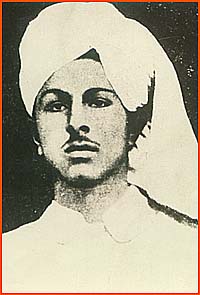
 Bhagat Singh (September 27, 1907 – March 23, 1931) was an Indian freedom fighter, considered to be one of the most influential revolutionaries of the Indian independence movement. He gained support when he underwent a 63-day fast in jail, demanding equal rights for Indian and British political prisoners. He was hanged for shooting a police officer in response to the killing of veteran freedom fighter Lala Lajpat Rai. His legacy prompted youth in India to begin fighting for Indian independence and also increased the rise of socialism in India. Bhagat Singh was born in the Khatkar Kalan village near Banga in the Lyallpur district of Punjab. Singh's given name of Bhagat means "devotee". He came from a patriotic Sikh family, some of whom had participated in movements supporting the independence of India and others who had served in Maharaja Ranjit Singh's army. At the age of 13, he began to follow Mahatma Gandhi's Non-Cooperation Movement. By doing so he had openly defied the British and had followed Gandhi's wishes by burning his government school books and any British-imported clothing. Following Gandhi's withdrawal of the movement after the violent murders of policemen by villagers from Chauri Chaura, Uttar Pradesh, he became disgruntled with Gandhi's nonviolence action, joined the Young Revolutionary Movement and began advocating a violent movement against the British. In September 1928, a meeting of various revolutionaries from across India was called at Delhi under the banner of the Kirti Kissan Party. Bhagat Singh was the secretary of the meeting. His later revolutionary activities were carried out as a leader of this association. The capture and hanging of the main HRA Leaders also allowed him to be quickly promoted to higher ranks in the party, along with his fellow revolutionary Sukhdev Thapar.
 As a consequence of the actions by the revolutionaries, the British government enacted the Defence of India Act to give more power to the police. The purpose of the Act was to combat revolutionaries like Bhagat Singh. The Act was defeated in the council by one vote. However, the Act was then passed under the ordinance that claimed that it was in the best interest of the public. In response to this act, the Hindustan Socialist Republican Association planned to explode a bomb in the assembly where the ordinance was going to be passed. It was decided that Bhagat Singh and Batukeshwar Dutt, another revolutionary, would throw the bomb in the assembly
On April 8, 1929, Singh and Dutt threw a bomb onto the corridors of the assembly and shouted "Inquilab Zindabad!" ("Long Live the Revolution!"). The bomb neither killed nor injured anyone. Singh and Dutt claimed that this was deliberate on their part, a claim substantiated both by British forensics investigators who found that the bomb was not powerful enough to cause injury, and by the fact that the bomb was thrown away from people. Singh and Dutt gave themselves up for arrest after the bomb.
While in jail, Bhagat Singh and other prisoners launched a hunger strike advocating for the rights of prisoners and those facing trial. The reason for the strike was that British murderers and thieves were treated better than Indian political prisoners, who, by law, were meant to be given better rights. The aims in their strike were to ensure a decent standard of food for political prisoners, the availability of books and a daily newspaper, as well as better clothing and the supply of toilet necessities and other hygienic necessities. He also demanded that political prisoners should not be forced to do any labour or undignified work. During this hunger strike that lasted 63 days and ended with the British succumbing to his wishes, he gained much popularity among the common Indians. Before the strike his popularity was limited mainly to the Punjab region.
On March 23, 1931, Bhagat Singh was hanged in Lahore with his fellow comrades Rajguru and Sukhdev. His supporters, who had been protesting against the hanging, immediately declared him as a shaheed or martyr. Singh was cremated at Hussainiwala on banks of Sutlej river. Today, the Bhagat Singh Memorial commemorates freedom fighters of India.


